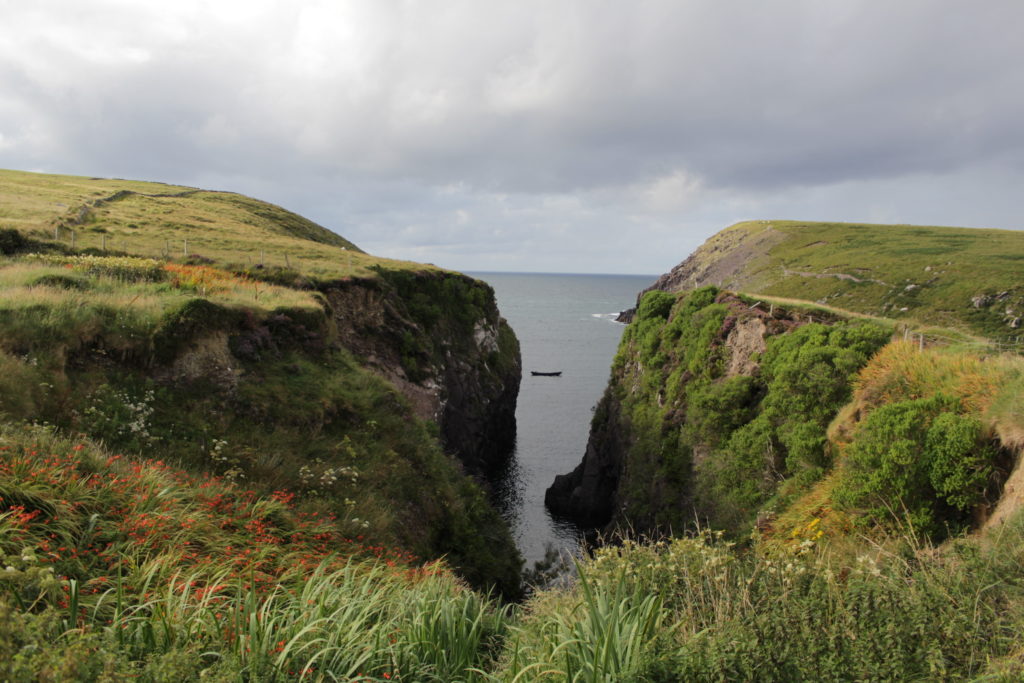
Every now and then you come across a guesthouse that feels like you are simply visiting an old friend. Our hostess at our guesthouse in Dingle is such a welcoming and helpful lady. She has given us all the insider tips for making the most of our time on the Dingle Peninsula.
First, we took a drive over Connor’s pass. We were warned that parts of this pass can be daunting. It was rather. At times, there was absolutely no way of passing an oncoming vehicle. But the views are spectacular! We stopped at the top of the pass, and I ventured up the hill to the top of the mountain. Quite a strenuous walk for my level of fitness, but it feels like you can see the entire peninsula, so well worth it.


Next we set off on the circular drive around the western part of the peninsula. Clockwise, as we were advised, to be sure that you are not faced with oncoming buses. The peninsula boasts with a few sights that date back to potentially the 6th to 8th century. We briefly stopped at the huts, before heading for Slea Head. Another rather strenuous trek across the hill, but another exceptional wow moment as an award, with beautiful views of the Blasket Islands.


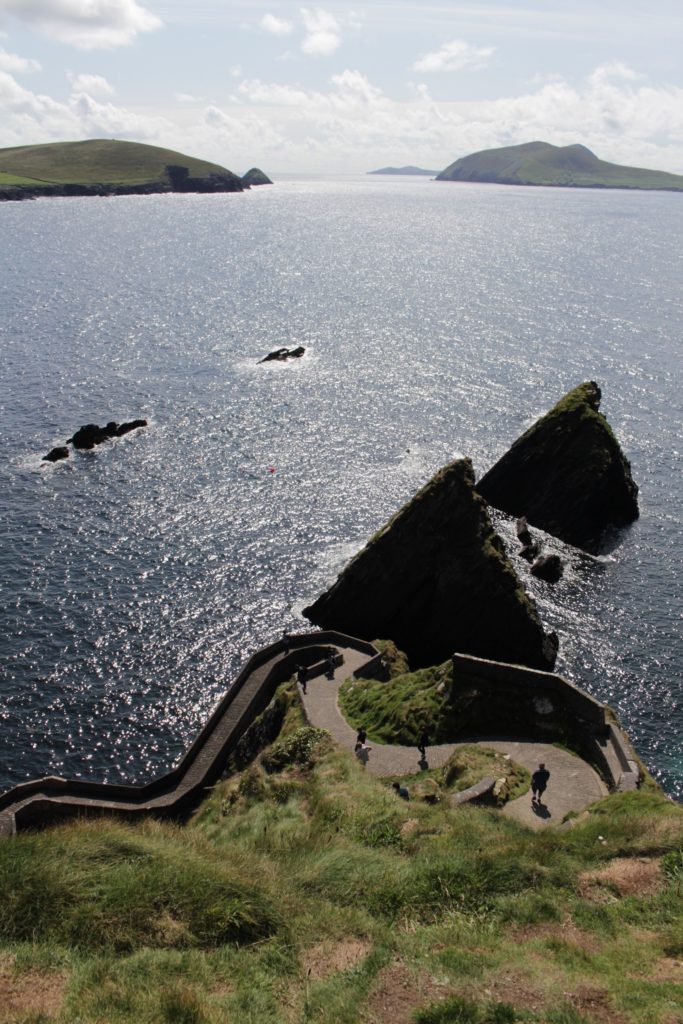
One of the photo’s I had seen of The Dingle peninsula was of a small harbour at the bottom of a rather high hill / cliff. I wasn’t quite sure where exactly it was, and imagined that it was further down the slopes of the hill we had just been over, and so I figured that that would he one of the misses. But a little further along the way, a sign caught my eye. It turns out I was looking for Dunquin harbour. A tiny harbour at the bottom of a steep walkway. The pier is also known as the Sheep Highway. In times when the Blasket Islands were still inhabited, the farmers used to bring their sheep by boat to Dunquin harbour, and up the steep pier. It seems that, despite many attempts of signs and bollards to prevent motorists from driving down the pier, one or two may have attempted this, and had to incur a rather steep bill for assistance to get their cars back up the hill. I can just hear the Irish go ‘…..eejit’.


By the way – the Irish has 15 ways of telling someone they are an idiot. Eejit is only 12th on the list.
Our drive around Peninsula continued with regular stops. Just when you think that that was probably the last of the good views, you turn a corner and another breathtaking view presents itself to you. The Dingle Peninsula is just exquisite.
No real evidence has been discovered to shed light on exactly what the little stone hut that is the Gallarus Oratory was actually used for. Some believe it to have been an early Christian stone church. Others suspect it to be a shelter for pilgrims. It is estimated to have been built in the 12th century. Either way, it has managed to last through centuries of harsh weather. I’m just hoping that the many tourists that now visit it, pay it enough respect to ensure that it can last a few more.

The Church of Kilmalkedar also dates back to the mid-12th century. It seems to have been an assembly site for pilgrims on their way to Mount Brandan. An Alphabet stone and Ogham stone date back to AD 550-600.


At times, today, we felt that we may have exhausted our quota of wow moments. The Dingle Peninsula just never stops to impress. You just continue to encounter its beauty. Ag am ar bith.


Wesme, I am so enjoying reading your wonderful stories and pictures of your travels in Ireland. Enjoy! And keep writing…. Niel, I recall asking you to have a Guinness for me. By now I’m sure you’ve had several! No problem. I somehow doubt that the Irish are any good at making red wine. ?