10/09/2014
The national flower of Namibia is the Welwitschia. It is unique in the Namib, and is in fact a coniferous dwarf tree that is related to the pine tree. It appears as though the Welwitschia has many intertwined leaves, but in reality there are only two leaves which continue to grow throughout its lifespan. As time passes, these are torn into thinner shreds. The plants are unisexual, and are sometimes referred to as living fossils.
Today we went on a self-drive tour to view this very plant. We quite fancied the very informative leaflet we got with the permit allowing us to drive around the Namib-Naukluft park.
First we learnt all about how, even though the area looks dry and barren, the ground and stones are often covered with a great variety of lichens. These little plants depend on the mist that moves in from the sea over the desert at night, and look like black fragments of dead plant material. But should you be kind enough to water them a little, they suddenly come to life. Pretty cool.


Hardly any plants survive in this area. But the Dollar Bush with its round leaves, and the Ink Bush seem to at least hold its own a little.


But then you reach the Swakop Valley Moon landscape. This is something that cannot be described, or even photographed. On a slight hill, in the deadly silence of the Namib desert, the view over this vast and desolate landscape is breathtakingly beautiful.

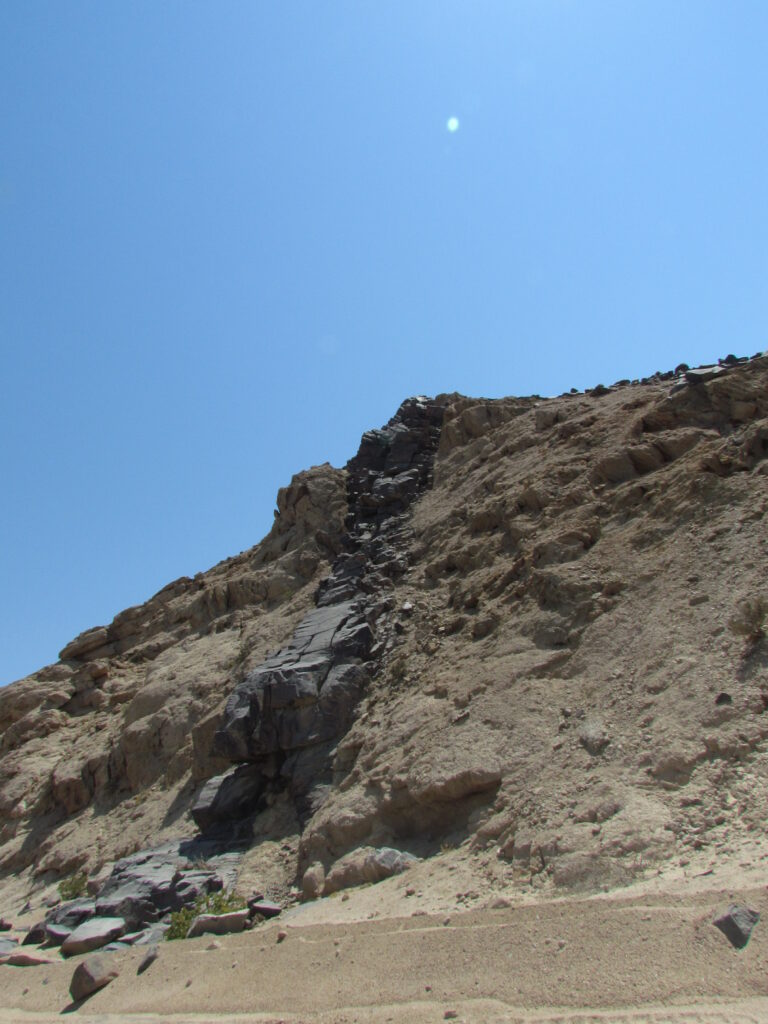
The Swakop river bed is surrounded by hills. Most of these hills have a black ridge running along their ridge, making them look a little like the spines of dinosaurs. In fact, these are dolorite ridges. Dolerite is a hard igneous rock, formed from molten lava, and takes longer to weather than the surrounding rock, which results in the thin band of black dolerite along the hill tops.

Shortly after passing through the green, but dry river valley, we started to see the Welwitschias. I can easily see why people would consider them to be living fossils. They are rather odd. But the biggest reason for this is probably because the one at the furthest point of our drive, is estimated to be 1 500 years old. And a female, from what I gather from Googling a little. Stately old lady, she is too.


Next we drove along the endless ridge of dunes, to Walvisbay, to see if we could see some bird life. We found the flamingos near the saltworks, and had endless fun trying to get them to take off in their ever so stately flight. I have a colleague at work who has been trained rather nicely to react to the good old “KeKaaa” call. He pipes up like a prairie dog immediately at the sound of my call. The same can not be said for the flamingos. It took some performance to get them to fly, and then we rarely managed to get them in our cameras’ sights. But we had fun nonetheless.


We ended the day off with a visit to the local craft market in Swakopmund, and had a rather hard time convincing the locals that we could not possibly buy something from everyone. By far the most fascinating must be the keyrings that are made from the seeds of the makalani palm tree. They eat the fruit, and then carve shapes into the seed. I was amazed at how quickly they are able to carve your name in tiny letters on this seed.
Supper was at Kücki’s Pub – one of the recommended places that we were unable to find place at the previous night. It was well worth the while. On the wall outside this pub they have a huge sign: ‘Hot beer, Lousy food, Bad service, Welcome” I cannot really say that that was the case. The place has a nice vibe, and the food was far from lousy.
Tomorrow we head off to Sossusvlei. The weather forecast shows temperatures up to 34 degrees on Saturday. I’m not entirely scared off.


Dankie vir al die mooi fotos en detail van die “vakansie”. Geniet dit. Verlang vir julle.